
Table of Contents
ToggleOrnamental grasses bring texture, movement, and year-round interest to front yards without the fuss of traditional flower beds. They thrive in conditions where perennials struggle, need minimal watering once established, and deliver dramatic visual impact from spring through winter. Whether someone’s working with full sun or partial shade, slopes or flat terrain, there’s a grass species that fits the site. This guide walks through selection, design strategy, and installation, so homeowners can create a low-maintenance, high-impact landscape that stands out on the block.
Key Takeaways
- Ornamental grasses for front yard landscaping require minimal watering, fertilization, and maintenance while delivering year-round visual interest from spring through winter.
- Choose grass species based on site conditions: maiden grass and fountain grass thrive in full sun (6+ hours), while Japanese forest grass and northern sea oats excel in partial shade (3–6 hours).
- Proper planting depth, spacing following mature width recommendations, and consistent watering for 6–8 weeks after installation are critical to establishing healthy grasses.
- Design with mass plantings, layered borders, or focal points to maximize the dramatic texture and movement that ornamental grasses bring to front yard landscapes.
- Cut back grasses to 4–6 inches in late winter, divide clumps every 3–5 years, and avoid over-fertilization to maintain vigor and prevent disease.
Why Ornamental Grasses Are Perfect for Front Yard Landscapes
Ornamental grasses offer practical advantages that make them ideal for front-yard installations. Unlike shrubs or annuals, they require minimal fertilization, rarely attract pests, and handle drought better than most groundcovers once their roots establish.
Most varieties reach maturity in one to two seasons and don’t demand constant pruning. A single cutback in late winter or early spring keeps them tidy. Native and adapted species (like little bluestem or switchgrass) integrate well with eco-friendly landscaping approaches, reducing irrigation and chemical inputs.
Grasses add movement and sound, their blades sway in the breeze and rustle softly, creating a dynamic element that static plants can’t match. Seedheads persist through fall and winter, catching frost and providing texture when perennials have died back. This four-season interest keeps front yards from looking barren in colder months.
From a design standpoint, grasses work as borders, focal points, or mass plantings. Their vertical forms contrast with rounded shrubs and horizontal groundcovers, adding layers that guide the eye. They’re also forgiving: if a clump underperforms, it’s easy to divide or relocate without major landscape disruption.
Choosing the Right Ornamental Grasses for Your Front Yard
Selecting grasses starts with site assessment: sun exposure, soil drainage, and mature plant dimensions. A grass that tops out at 6 feet works in a corner bed but overwhelms a narrow strip beside a walkway. Measure planting areas and note how many hours of direct sun they receive daily.
Best Ornamental Grasses for Sunny Front Yards
Full-sun locations (6+ hours of direct light) support the widest range of species. Maiden grass (Miscanthus sinensis) grows 4–8 feet tall depending on the cultivar, producing arching foliage and plumed seedheads in late summer. ‘Morning Light’ offers narrow, white-edged blades: ‘Gracillimus’ stays more compact at 4–5 feet. Space clumps 3–4 feet apart to allow airflow and reduce fungal issues.
Fountain grass (Pennisetum alopecuroides) reaches 2–4 feet with bottlebrush-like blooms in midsummer. It works well as a border or repeated accent. ‘Hameln’ is a dwarf selection that fits smaller beds. Note: some Pennisetum species self-seed aggressively in warm climates: check local invasive species lists before planting.
Little bluestem (Schizachyrium scoparium) is a North American native that turns orange-red in fall, holding color through winter. It grows 2–3 feet tall, tolerates poor soil, and requires zero supplemental water after establishment in most regions. It’s a strong choice for low-maintenance front plantings.
Switchgrass (Panicum virgatum) offers upright structure and airy seedheads. Cultivars like ‘Heavy Metal’ deliver metallic blue foliage that shifts to gold in fall. Mature height ranges from 3–6 feet: plant in groups of three or five for visual impact.
Karl Foerster feather reed grass (Calamagrostis × acutiflora) is a reliable performer in zones 4–9, producing stiff, vertical flower spikes by early summer. It tolerates clay and doesn’t flop in wind or rain. Mature clumps reach 4–5 feet tall and 2 feet wide.
Shade-Tolerant Grasses for Low-Light Areas
Partial shade (3–6 hours of sun) limits options, but several grasses thrive under these conditions. Japanese forest grass (Hakonechloa macra) forms cascading mounds 12–18 inches tall with bright chartreuse or variegated foliage. It prefers moist, well-drained soil and works well under tree canopies or along shaded walkways.
Northern sea oats (Chasmanthium latifolium) grows 2–4 feet tall and tolerates dry shade once established. Its flat, dangling seedheads persist through winter and add architectural interest. This species self-sows moderately: deadhead spent blooms if reseeding is a concern.
Sedges (Carex species) technically aren’t true grasses but fill the same design role. Pennsylvania sedge (Carex pensylvanica) forms a low groundcover 6–8 inches tall, ideal for shaded slopes or areas where turf struggles. Appalachian sedge (Carex appalachica) reaches 8–12 inches and tolerates foot traffic better than most ornamental grasses.
Design Ideas for Incorporating Ornamental Grasses
Grasses work in multiple landscape roles, from standalone specimens to supporting players in mixed beds. Plan placements based on mature size, bloom timing, and how neighboring plants interact.
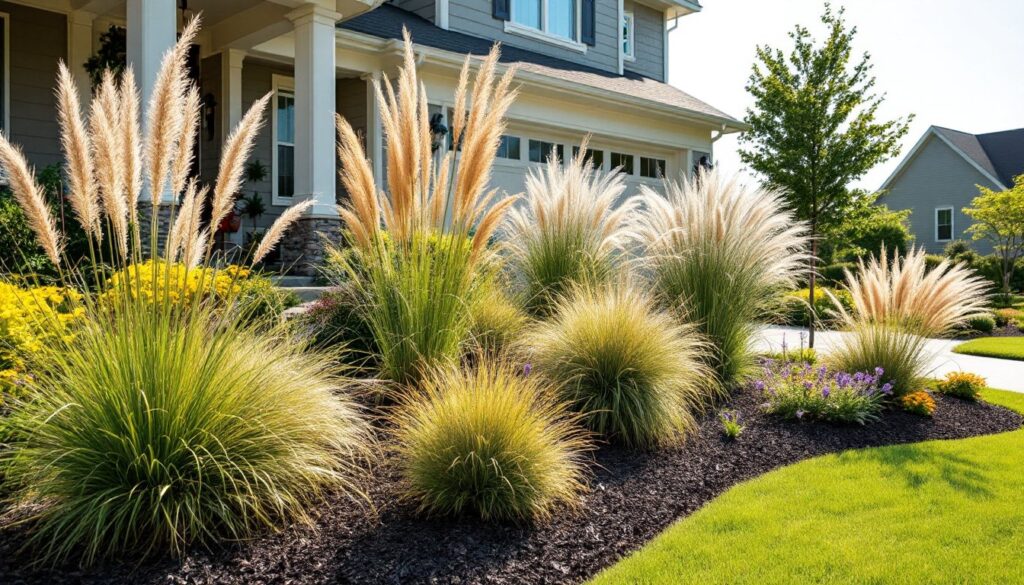
Mass plantings create bold, unified sweeps of texture. Use a single species in groups of seven or more along a property line or driveway edge. Stagger rows in a triangular pattern rather than straight lines, it looks more natural and fills in faster.
Layered borders combine grasses with perennials and shrubs. Place taller varieties like maiden grass or switchgrass at the back, mid-height fountain grass in the middle, and low sedges or groundcovers at the front. This creates depth and keeps shorter plants visible. Designers sometimes incorporate crepe myrtles as vertical anchors alongside tall grasses for a multi-season display.
Focal points work best with dramatic specimens. Plant a single clump of pampas grass (Cortaderia selloana) in a corner bed or island, where its 8–10-foot plumes draw attention. Be aware: pampas grass is invasive in coastal California and parts of the Southeast, check regulations before planting.
Edging and pathways benefit from compact, mounding grasses. Line a front walk with blue fescue (Festuca glauca) or dwarf fountain grass spaced 12–18 inches apart. Their rounded forms soften hardscape edges without encroaching on pavement.
Slope stabilization is a practical application for deep-rooted grasses. Plant switchgrass, big bluestem, or prairie dropseed (Sporobolus heterolepis) on banks or berms to prevent erosion. Their fibrous roots hold soil better than shallow-rooted annuals, and they don’t require the mowing that turf does on steep grades. According to Gardenista, grasses excel in challenging spots where other plants fail.
Color and texture contrast elevates grass plantings. Pair blue-toned grasses like ‘Heavy Metal’ switchgrass with warm-colored perennials (coneflowers, rudbeckia) for complementary contrast. Place fine-textured grasses next to bold-leaved hostas or bergenia to emphasize differences. Repetition matters, repeat a single grass variety at intervals throughout the bed to create visual rhythm.
Planting and Care Tips for Long-Lasting Results
Proper installation and early care determine whether grasses thrive or struggle. Most failures come from poor drainage, planting too deep, or neglecting water during establishment.
Timing: Plant container-grown grasses in spring or early fall when soil temps are 50–65°F. This gives roots time to establish before summer heat or winter cold. Avoid planting during peak summer unless consistent irrigation is available.
Soil prep: Grasses tolerate a range of soil types, but all benefit from loosened planting areas. Till or turn soil to a depth of 8–12 inches, breaking up compacted layers. Amend heavy clay with compost or aged bark at a 2:1 ratio (2 parts native soil to 1 part amendment) to improve drainage. Sandy soils benefit from the same amendment to boost moisture retention. Skip high-nitrogen fertilizers, grasses planted in over-fertile soil grow weak and flop.
Planting depth: Dig holes as deep as the root ball and twice as wide. Set the crown (where roots meet stems) level with the surrounding grade. Planting too deep invites crown rot: too shallow exposes roots to drying. Backfill with native soil, firm gently, and water thoroughly to eliminate air pockets.
Spacing: Follow mature width recommendations, typically 1.5 to 2 times the expected spread. Crowding reduces airflow and increases disease risk. If planting in groups, triangular spacing fills in faster than grid patterns.
Watering: Newly planted grasses need consistent moisture for the first 6–8 weeks. Water deeply 2–3 times per week, delivering 1 inch total per week (including rainfall). Once established, most grasses survive on rainfall alone except during prolonged drought. Avoid overhead irrigation, drip lines or soaker hoses reduce foliar disease.
Mulching: Apply 2–3 inches of shredded bark or wood chips around each clump, keeping mulch 2–3 inches away from the crown. Mulch conserves moisture, suppresses weeds, and moderates soil temperature. Replenish annually as it decomposes.
Pruning: Cut grasses back to 4–6 inches above the crown in late winter before new growth emerges. Use bypass loppers, hedge shears, or a string trimmer depending on clump size. For large plantings, some pros bundle foliage with bungee cords and cut through with a chainsaw, wear safety goggles, gloves, and hearing protection if using power tools. Leaving foliage through winter protects crowns and provides habitat for beneficial insects.
Division: Most grasses benefit from division every 3–5 years to maintain vigor. Dig clumps in early spring, split them with a sharp spade or saw, and replant divisions at the same depth. Discard woody centers: keep outer sections with active growth.
Pests and diseases: Grasses rarely face serious issues. Occasional rust or leaf spot may appear in humid climates, remove affected foliage and improve air circulation. Deer and rabbits typically avoid ornamental grasses. Southern Living notes that grasses’ low pest pressure makes them reliable choices for homeowners seeking easy landscaping solutions.
Fertilization: Apply a slow-release, balanced fertilizer (10-10-10) in early spring if growth seems weak. Most grasses don’t need annual feeding, over-fertilization causes floppy foliage. Native species like little bluestem and switchgrass require zero supplemental nutrients.
Conclusion
Ornamental grasses deliver curb appeal with minimal upkeep, adapting to a range of light and soil conditions. Choosing species that match site conditions and spacing them correctly sets the stage for years of low-maintenance performance. With proper installation and annual cutback, these plantings offer texture, movement, and year-round interest that traditional landscapes can’t match.