
Table of Contents
ToggleA raised deck can be one of the best features of a home, until weeds start creeping through the lattice, bare dirt turns into a mud pit after rain, and the landscaping underneath becomes a neglected eyesore. Tackling the area around a raised deck presents unique challenges. Slopes, shade, limited access, and irregular spaces make traditional gardening a headache. But with the right approach, homeowners can transform that trouble spot into a low-effort, attractive landscape that stays tidy year-round. This guide covers practical strategies for creating a low maintenance landscape around raised decks, from choosing the right plants to smart hardscaping solutions that keep yard work to a minimum.
Key Takeaways
- Low maintenance landscaping around raised decks eliminates weeding and watering hassles by using mulch, hardscaping, and drought-tolerant plants adapted to shaded, compacted soil conditions.
- Plan your deck landscape by evaluating slope, sun exposure, moisture levels, and accessibility before selecting plants or materials to address zone-specific needs effectively.
- Choose native perennials like hostas, ferns, and ornamental grasses for shaded areas, and sedums with creeping thyme for sunny spots—these require minimal deadheading, staking, or dividing.
- Install landscape fabric (3 oz. per square yard) topped with 3–4 inches of hardwood bark mulch or river rock to suppress weeds and create a finished appearance under the deck.
- Use hardscaping elements like retaining walls, permeable pavers, and steel edging to reduce yard work, prevent erosion, and maintain clean lines around deck footings.
- Perform seasonal maintenance: refresh mulch in spring, spot-treat weeds in summer, remove fall leaves, and monitor drainage—minimal effort keeps your landscape thriving year-round.
Why Low Maintenance Landscaping Works Best for Raised Decks
The space beneath and around a raised deck creates specific conditions that make high-maintenance plantings impractical. Most raised decks cast shade for much of the day, limiting what will grow successfully. The soil underneath often becomes compacted during construction, and accessing the area for watering, pruning, or fertilizing means crawling under joists or reaching through deck boards, tasks nobody wants to do weekly.
Low maintenance landscaping eliminates these hassles. Instead of fighting against difficult conditions, this approach uses mulch layers, hardscaping materials, and drought-tolerant plants that thrive on neglect. Once established, these landscapes require minimal intervention, maybe seasonal cleanup and occasional mulch top-offs.
From a practical standpoint, raised decks often violate the accessible garden rule: if you can’t reach it comfortably, you won’t maintain it. Designing for low upkeep from the start saves time and money over the deck’s lifetime. It also prevents the all-too-common scenario where the deck perimeter becomes a dumping ground for leaves, tools, and forgotten projects.
Planning Your Low Maintenance Deck Landscape
Before buying a single plant or bag of gravel, evaluate what’s already there. Check the slope, runoff and erosion can undermine deck footings if not managed. Note sun exposure throughout the day: north-facing deck sides may receive almost no direct light. Measure the accessible areas and identify any utilities or posts that limit design options.
Consider moisture levels. Areas directly under the deck stay dry, while perimeter zones may collect runoff from deck boards and downspouts. This variance affects plant selection and drainage solutions. If the deck lacks a french drain or proper grading, address that first. Standing water around footings accelerates rot and attracts mosquitoes.
Sketch a simple plan dividing the space into zones: full shade under the deck, partial shade along the edges, and sun-exposed areas beyond the deck’s shadow. Each zone gets different treatments. For instance, shade zones might receive a landscape fabric barrier topped with river rock, while sunny perimeter beds can support ground cover plants that spread without aggressive maintenance.
Budget realistically. Quality landscape fabric, several cubic yards of mulch or stone, and enough plants to fill in within two growing seasons cost more upfront than a bag of wildflower seeds. But that initial investment pays off by eliminating years of weeding, watering, and replanting. Plan for edging materials like metal or composite borders to keep mulch contained and create clean lines that reduce trimming work.
Best Low Maintenance Plants for Around Raised Decks
Plant selection makes or breaks a low maintenance landscape. Choose species adapted to local climate and the specific conditions around the deck. Native plants require less water and resist local pests better than imports. Perennials eliminate the annual replanting cycle of bedding plants.
For shaded areas under or beside the deck, try hostas, which tolerate deep shade and come in dozens of varieties. Ferns like autumn fern (Dryopteris erythrosora) or Japanese painted fern (Athyrium niponicum) add texture and thrive with minimal care. Coral bells (Heuchera spp.) offer colorful foliage in part shade and require no deadheading.
In sunny spots, ornamental grasses such as blue fescue (Festuca glauca) or fountain grass (Pennisetum alopecuroides) provide structure and movement with zero fuss. Cut them back once in early spring and they’re set for the year. Sedums and other succulents handle heat, drought, and poor soil, ideal for slopes or areas with shallow topsoil.
Avoid plants that demand deadheading, staking, dividing every few years, or specific soil amendments. Skip anything labeled “vigorous spreader” unless contained by hardscaping: that’s code for “will invade the entire yard.” If choosing shrubs, look for compact cultivars that won’t outgrow their space and require constant pruning. Boxwoods, dwarf conifers, and spirea varieties like ‘Little Princess’ maintain their shape with minimal intervention.
Ground Cover Solutions That Require Minimal Care
Ground covers solve two problems: they suppress weeds and eliminate the need for mulching once established. For shade, pachysandra (Pachysandra terminalis) spreads reliably and stays evergreen in most climates. Sweet woodruff (Galium odoratum) tolerates dry shade and releases a pleasant scent when crushed.
In sunny zones, creeping thyme (Thymus serpyllum) forms a dense, fragrant mat that tolerates foot traffic and blooms in early summer. Creeping phlox (Phlox subulata) cascades over edges and requires no maintenance beyond an occasional trim. Both spread quickly enough to cover ground within two seasons but don’t become invasive like some low maintenance plants used in front yard applications.
Establish ground covers by planting plugs on 12-inch centers in spring. Water regularly the first season until roots establish, then back off. Lay landscape fabric before planting and cut X-shaped slits for each plug, this prevents weeds while the plants fill in. Once mature, these covers choke out weeds naturally and rarely need watering except during extreme drought.
Hardscaping Elements to Reduce Yard Work
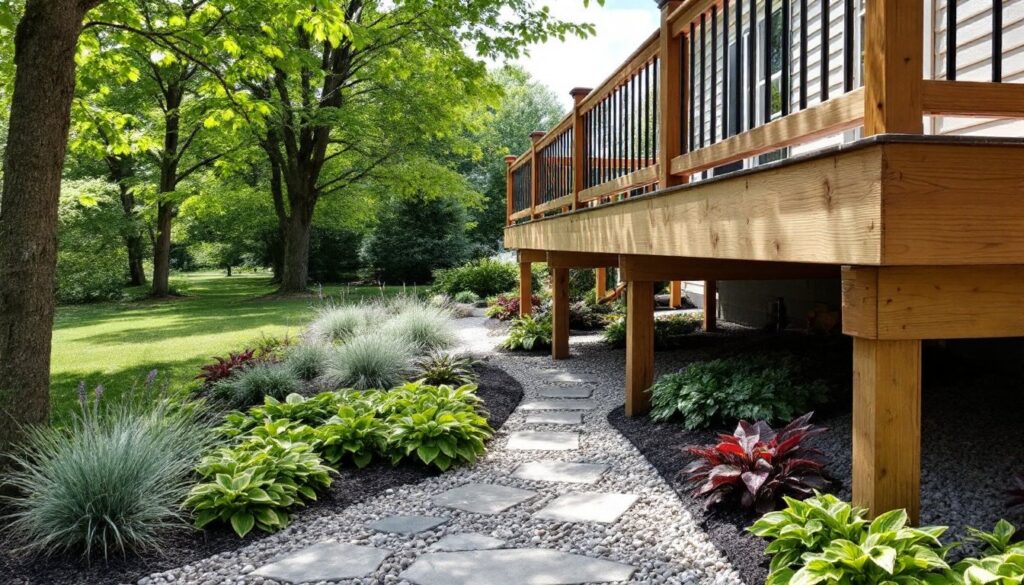
Hardscaping turns problem areas into zero-maintenance zones. Under the deck where nothing grows, a layer of landscape fabric topped with 3-4 inches of gravel or river rock creates a clean, finished look and prevents mud splash during rain. Use ¾-inch crushed stone for areas that need better drainage or 2-3 inch river rock for a more decorative appearance.
For sloped areas around deck footings, consider retaining walls built from concrete blocks or natural stone. These create level planting beds that are easier to maintain and prevent soil erosion. A low wall (12-18 inches tall) typically doesn’t require engineering or permits, but check local codes, anything over 4 feet usually needs a structural plan.
Stepping stone paths provide access for maintenance without compacting planting beds. Set flagstone or concrete pavers on a 2-inch sand base, spacing them 24 inches on center for a comfortable walking stride. This lets homeowners reach deck lattice or utilities without trampling plants.
For modern deck landscaping designs, permeable pavers offer the look of traditional hardscaping while allowing water infiltration. These reduce runoff and prevent puddles near the deck base. Installation is straightforward: excavate 6-8 inches, add 4 inches of crushed stone base, level with 2 inches of bedding sand, and set the pavers. Gaps between pavers can be filled with river rock or polymeric sand depending on the desired look.
Edging materials create a barrier between lawn and landscaped areas, eliminating the need for constant trimming. Steel edging bends easily for curves and lasts decades. Composite landscape edging resists rot and insects. Install edging deep enough, at least 3-4 inches below grade, to block grass roots from invading beds.
Mulching Strategies for Deck Perimeters
Mulch serves multiple functions: suppresses weeds, retains moisture, regulates soil temperature, and gives beds a finished appearance. For deck areas, choose mulches that last and don’t require frequent replacement.
Hardwood bark mulch (not dyed) breaks down slowly and stays in place better than shredded varieties on slopes. Apply 3-4 inches thick, keeping it 2-3 inches away from deck posts to prevent moisture contact that accelerates wood rot. Refresh annually by adding a 1-inch top layer as the existing mulch decomposes.
Pine bark nuggets (2-3 inch size) last longer than shredded mulch and resist washing away during heavy rain. They cost more initially but need replacement less often, every 2-3 years instead of annually. For areas under the deck where aesthetics matter less, consider brown or black rubber mulch. It never decomposes, won’t attract termites, and provides permanent coverage. Some jurisdictions have concerns about rubber mulch near waterways, so check local regulations.
Avoid cypress mulch, which may come from unsustainable sources, and cocoa hull mulch, which is toxic to pets and washes away easily. Don’t use fresh wood chips unless well-composted, they steal nitrogen from soil as they decompose, stunting plant growth.
Before mulching, install landscape fabric rated at least 3 oz. per square yard to block weeds without restricting water penetration. Overlap seams by 6 inches and secure with landscape staples every 3 feet. Cut X-shaped slits for plants. This fabric-plus-mulch combination virtually eliminates weeding for years.
On slopes, consider mulch glue or soil stabilizer netting to keep material from sliding downhill after storms. These products are especially useful in areas that receive concentrated runoff from deck drainage.
Maintaining Your Low Maintenance Landscape Year-Round
Even the lowest maintenance landscape needs seasonal attention, just far less than traditional plantings. Spring tasks include pulling any weeds that breached the mulch barrier, cutting back ornamental grasses before new growth emerges, and adding a fresh 1-inch mulch layer if needed.
Check that landscape fabric hasn’t shifted and that edging materials remain flush with the soil. Inspect deck footings for signs of erosion or settling. If mulch has washed into low spots, redistribute it and address the drainage issue causing the problem.
Summer maintenance is minimal: occasional watering during extreme drought (most established native plants and ground covers won’t need it), and spot-treating any persistent weeds with glyphosate-based herbicide applied carefully to avoid overspray on desirable plants. Wear gloves and eye protection when handling herbicides.
Fall brings cleanup. Remove leaves that accumulate under the deck to prevent them from smothering ground covers or creating damp conditions that promote rot. Trim back any perennials that have died back, though some gardeners leave ornamental grass plumes standing for winter interest.
Winter is hands-off. Well-designed low maintenance landscapes don’t require protection, winter watering, or any intervention. Use the time to plan any additions or changes for spring.
For truly minimal upkeep, consider drip irrigation on a timer for plant zones. A simple system with ½-inch poly tubing and emitters costs under $100 for a small area and eliminates hand-watering entirely. Run it off a hose timer set to water twice weekly during establishment, then reduce to weekly or as-needed.
Document what works and what doesn’t. If a plant struggles even though proper conditions, replace it with something more suitable. The goal is a landscape that thrives without constant intervention, which sometimes means learning through trial and observation what truly works in that specific microclimate around the deck.