
Table of Contents
ToggleArizona’s desert climate presents unique challenges for front yard landscaping, but it also opens the door to stunning, sustainable designs that stand out in any neighborhood. Homeowners who embrace xeriscaping principles and drought-tolerant plants can create eye-catching curb appeal while slashing water bills and maintenance time. The key is working with the climate, not against it. This guide walks through practical Arizona front yard landscaping strategies, from selecting the right native plants to incorporating hardscaping that handles intense sun and minimal rainfall. Whether the goal is to replace a thirsty lawn or start fresh, these ideas deliver both beauty and resilience.
Key Takeaways
- Arizona front yard landscaping thrives when designed around drought-tolerant natives and xeriscaping principles that slash water bills and maintenance time while adapting to extreme heat, low rainfall, and alkaline soil.
- Decomposed granite, river rock, and permeable pavers provide essential hardscaping solutions that reduce irrigated areas, improve drainage, and create visual interest without the heat retention of concrete or asphalt.
- Native cacti, succulents like agave, and colorful desert shrubs such as red bird of paradise and Texas sage deliver year-round curb appeal with minimal water and no need for traditional turf.
- Desert-adapted trees like palo verde and mesquite offer filtered shade while reducing cooling costs, but should be planted at least 10 feet away from structures and irrigation lines due to aggressive root systems.
- Strategic shade solutions—including ramadas, pergolas, and shade sails—protect plants and cool hardscaping while making outdoor spaces more inviting in Arizona’s intense sun.
- Local building codes in cities like Tucson and Scottsdale often require water-conserving landscaping and permeable surfaces, so checking with your planning department before major changes is essential.
Why Arizona Front Yards Require Special Landscaping Considerations
Arizona’s climate throws curveballs that temperate-zone landscaping can’t handle. Summer temperatures routinely top 110°F, and annual rainfall in Phoenix averages just 8 inches, less than half what a typical lawn needs to survive. Soil composition leans heavily alkaline (pH 7.5–8.5) and often features caliche, a cement-like hardpan layer that blocks root growth and drainage.
Water scarcity is the elephant in the yard. Many Arizona municipalities enforce outdoor watering restrictions, and some HOAs now prohibit traditional turf entirely. Homeowners who cling to Kentucky bluegrass face sky-high water bills and constant battle with heat stress and fungal diseases. Switching to desert-adapted landscaping isn’t just environmentally responsible, it’s practical.
Sun exposure is relentless. Plants that thrive in partial shade elsewhere may scorch in Arizona’s high-UV environment. Hardscaping materials like dark pavers or metal edging can become dangerously hot to the touch. Understanding microclimates, south-facing exposures versus shaded north walls, makes the difference between a plant that survives and one that thrives.
Local building codes in cities like Tucson and Scottsdale often include landscaping ordinances that promote water conservation. Some require a percentage of the yard to feature living plants, while others mandate permeable surfaces to reduce stormwater runoff. Check with the local planning department before installing extensive hardscaping or removing existing vegetation.
Drought-Tolerant Plants That Thrive in Arizona Front Yards
Selecting the right plants transforms an Arizona front yard from barren to breathtaking without requiring a full-time irrigation system. The goal is to choose species adapted to extreme heat, low water, and alkaline soil.
Native Cacti and Succulents for Low-Maintenance Beauty
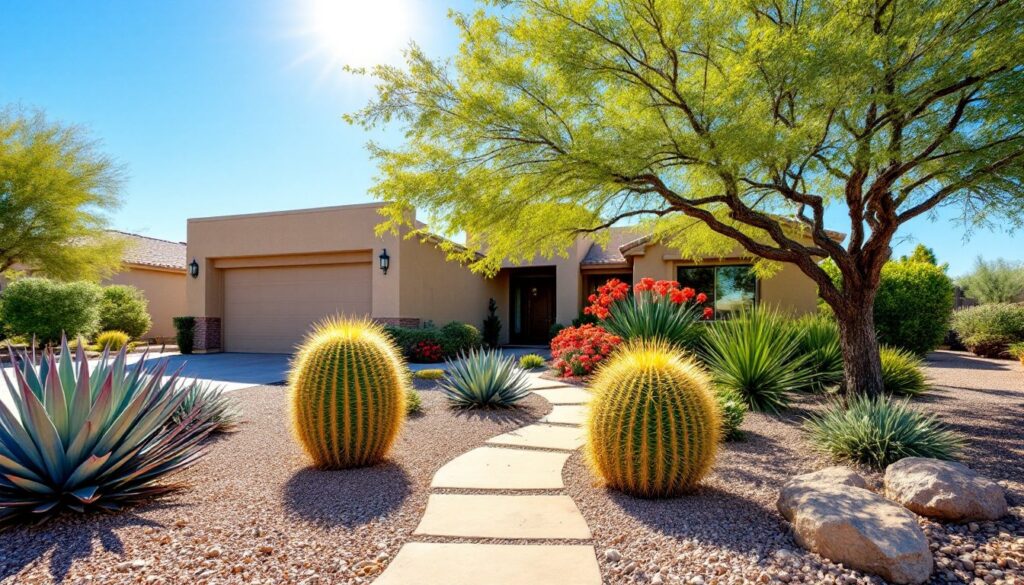
Native cacti deliver iconic desert character with near-zero water needs once established. Saguaro (Carnegiea gigantea) is the Arizona poster child, but it’s slow-growing and protected by state law, harvesting from the wild is illegal, so purchase nursery-grown specimens. For faster impact, consider golden barrel cactus (Echinocactus grusonii), which forms striking spherical clusters and tolerates full sun.
Prickly pear (Opuntia species) offers both sculptural form and edible pads and fruit. Varieties like Santa Rita prickly pear display purple-tinged pads that intensify in cooler months. Space them 3–4 feet apart to allow for mature spread. Ocotillo (Fouquieria splendens) adds vertical drama with spiny canes that leaf out after rain and produce vibrant red blooms in spring.
Succulents like agave provide bold focal points. Agave parryi (Parry’s agave) forms compact rosettes 1–2 feet wide, while century plant (Agave americana) can reach 6 feet across, plan accordingly. Agaves are monocarpic (they die after flowering), but offsets readily form at the base for propagation. Wear thick leather gloves and long sleeves when handling agave: the sap can cause skin irritation, and leaf tips are razor-sharp.
Colorful Desert-Adapted Flowers and Shrubs
Desert landscapes don’t have to be monochrome. Red bird of paradise (Caesalpinia pulcherrima) blooms from spring through fall with fiery orange-red flowers, attracting hummingbirds and butterflies. It’s technically a perennial shrub that freezes back in hard winters but rebounds quickly. Plant in full sun and give it room, mature size is 4–6 feet tall and wide.
Desert marigold (Baileya multiradiata) delivers cheerful yellow blooms nearly year-round and reseeds freely in disturbed soil. It’s perfect for filling gaps between larger specimens. Penstemon species (beardtongue) offer tubular flowers in shades of pink, red, and purple, thriving in rocky, well-drained soil.
For evergreen structure, Texas sage (Leucophyllum frutescens) is hard to beat. This shrub blooms profusely after monsoon rains, covering itself in tubular purple, pink, or white flowers. Many homeowners leverage low-maintenance plants to streamline care while boosting visual interest. Mature height ranges from 3 to 8 feet depending on variety. Prune lightly after flowering to maintain shape: avoid shearing into tight balls, which reduces bloom potential.
Fairy duster (Calliandra eriophylla) produces delicate pink puffball flowers and ferny foliage, staying compact at 2–3 feet. It’s deer-resistant and cold-hardy to 15°F. Pair it with desert spoon (Dasylirion wheeleri) for textural contrast, the latter forms a spiky sphere of silvery-blue leaves with a tall flower spike in early summer.
Hardscaping Elements to Reduce Water Use and Add Visual Interest
Hardscaping does heavy lifting in Arizona front yards, reducing irrigated areas while adding structure and curb appeal. Done right, it also improves drainage and keeps soil temperatures more stable.
Decomposed granite (DG) is a desert landscaping staple. This finely crushed stone compacts into a firm, permeable surface that comes in shades of tan, gold, rust, and gray. Spread a 3–4 inch base layer over compacted soil, then top with 1–2 inches of stabilized DG for pathways and open areas. Edge with steel or aluminum landscape edging to prevent migration into planting beds. DG heats up in summer but cools quickly after sunset, unlike concrete or asphalt.
Integrating landscaping river rock creates visual contrast and excellent drainage around plant root zones. Use 1–3 inch river rock as mulch in planting beds to suppress weeds and retain soil moisture. Darker stones absorb more heat, which can stress shallow-rooted plants, stick with lighter colors (tan, buff, pale gray) near delicate specimens. Larger 6–12 inch boulders serve as sculptural anchors: group them in odd numbers (three or five) for a natural look.
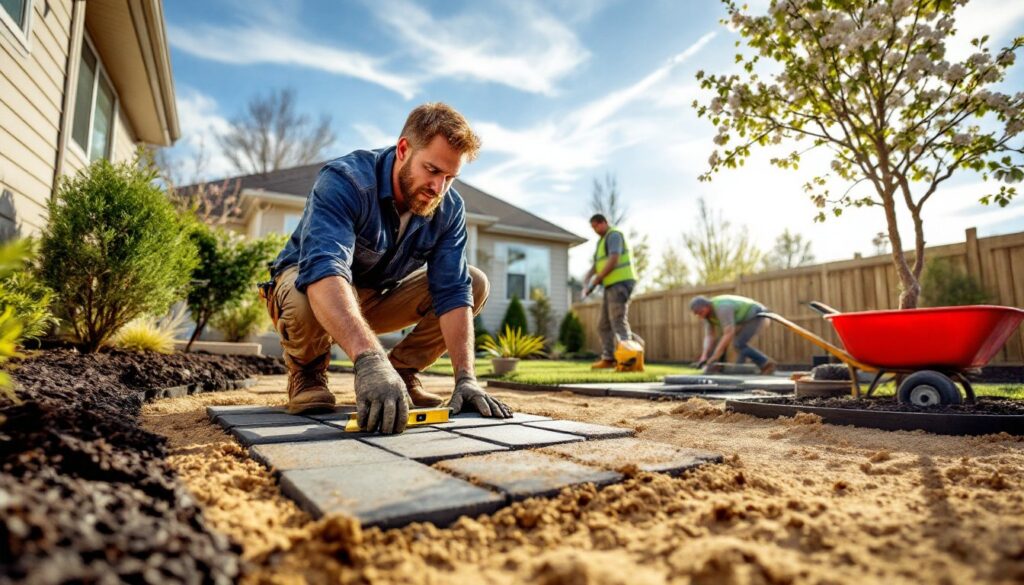
Flagstone or pavers define walkways and patios. Flagstone in earth tones (buff, red, gray) suits desert aesthetics and stays cooler underfoot than poured concrete. Set stones in decomposed granite with 1–2 inch joints, or mortar them over a concrete base for a more formal look. Permeable pavers allow rainwater infiltration, critical in areas with clay or caliche soil where runoff is a concern.
Consider a dry creek bed for visual interest and functional drainage. Dig a shallow swale 1–2 feet wide following the yard’s natural slope, line it with landscape fabric, and fill with river rock. Plant native grasses or desert willow along the edges. During monsoon season, it channels runoff safely away from the foundation: the rest of the year, it’s a striking landscape feature. Designers at Gardenista often showcase dry creek beds as elegant solutions for managing seasonal water flow.
Retaining walls solve slope challenges while adding dimension. In compact front yards, incorporating small retaining walls maximizes usable space and creates planting terraces. Stack natural stone or use modular concrete block systems rated for the wall height. Walls over 4 feet typically require engineering and permits under the International Residential Code (IRC), so consult local building officials before breaking ground. Backfill with well-draining gravel and install weep holes or perforated drain pipe to prevent hydrostatic pressure buildup.
Creating Shade and Outdoor Comfort in Your Arizona Front Yard
Arizona’s sun is merciless, and a front yard without shade is a front yard nobody wants to linger in. Strategic shade elements protect plants, cool hardscaping, and make the entry more inviting.
Desert-adapted trees are the long game. Palo verde (Parkinsonia species) is Arizona’s state tree, offering filtered shade and spring blooms in yellow or white. Mature height reaches 20–30 feet with a similar spread. Its green bark photosynthesizes even after leaf drop, a drought adaptation. Mesquite (Prosopis species) provides dappled shade and fixes nitrogen in the soil, benefiting nearby plants. Both trees have aggressive root systems, plant at least 10 feet from hardscaping, irrigation lines, and foundations.
Desert willow (Chilopsis linearis) stays smaller (15–25 feet) and produces orchid-like flowers in pink, purple, or white throughout summer. It’s deciduous, so winter shade is minimal, but that allows low-angle sun to warm the house during cooler months. Prune desert trees minimally: over-pruning stimulates excessive water-hungry growth and ruins natural form.
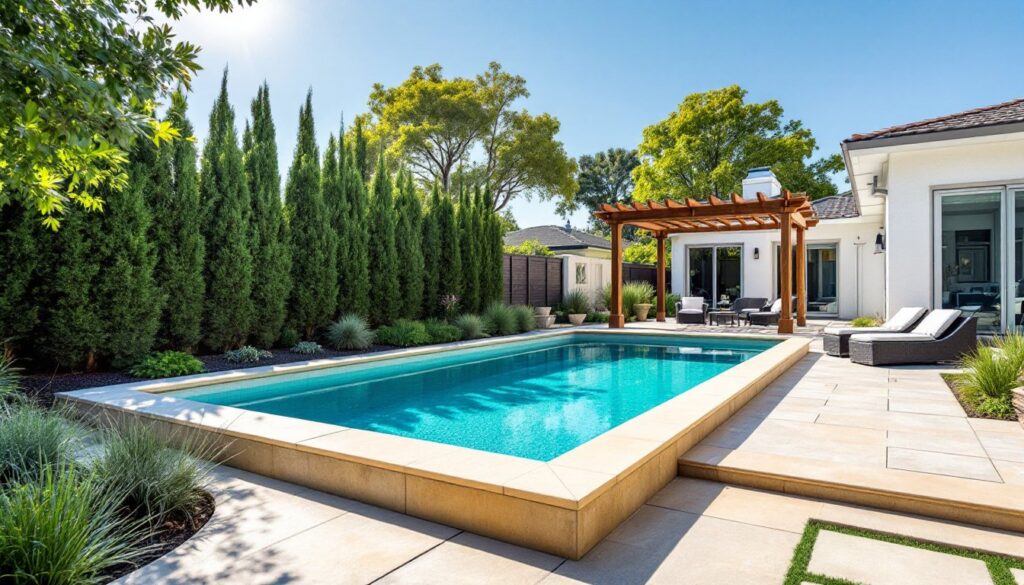
Ramadas and pergolas deliver instant shade. A ramada is a simple post-and-beam structure with a flat or slightly sloped roof, traditionally covered with ocotillo ribs, bamboo, or lattice. Modern versions use treated lumber or steel posts with slatted wood or fabric shade cloth on top. Shade cloth comes in densities from 30% to 90%: 50–70% blocks enough sun to cool the area without creating a cave-like feel. Anchor posts in concrete footings at least 18 inches deep (check local frost line requirements).
Pergolas add architectural detail and support vines. Train heat-tolerant climbers like queen’s wreath (Antigonon leptopus) or yellow orchid vine (Mascagnia macroptera) over the beams for seasonal shade. Avoid English ivy or other high-water vines. Pergola lumber exposed to Arizona sun needs protection, apply exterior-grade stain or sealant every 2–3 years to prevent cracking and UV degradation.
Shade sails offer a contemporary look and flexible placement. These tensioned fabric triangles or squares mount to posts, walls, or existing structures. Use marine-grade stainless steel hardware and UV-resistant fabric rated for at least 5 years of sun exposure. Position sails to block afternoon (west) sun, which is the most intense. Installing a shade sail requires measuring angles and pre-tensioning the fabric, it’s a two-person job, and if corners aren’t properly anchored, monsoon winds will tear it loose.
For front entries, a covered porch or portico is a smart investment. It shades the door and cools the threshold, cutting cooling costs and making arrivals more pleasant. Resources like The Spruce offer detailed guides on building or retrofitting porch covers to match existing architecture. Extend the roof 4–6 feet from the door for meaningful shade: shallower overhangs barely help. If the porch supports a second story or is over 8 feet deep, consult a structural engineer and pull permits, improperly braced covers can fail in high winds.
Conclusion
Arizona front yards don’t have to choose between beauty and sustainability. By leaning into drought-tolerant natives, smart hardscaping, and strategic shade, homeowners create landscapes that handle extreme heat, conserve water, and turn heads. Start small, swap one section of turf for decomposed granite and a cluster of agave, or plant a palo verde to anchor the design. The desert rewards those who work with it, not against it.